5 Areas Your Employees Must Be Trained For Corporate Success
Your employees show up every day. They work hard. They try their best. But are they trained in the right areas to actually help your company succeed?
Here’s a shocking truth: Only 47% of employees strongly agree they have the skills needed to excel in their current role. That’s less than half!
Even worse, 39% of core technical skills are expected to become outdated or transformed by 2030. Almost half of what workers know today won’t matter in just a few years!
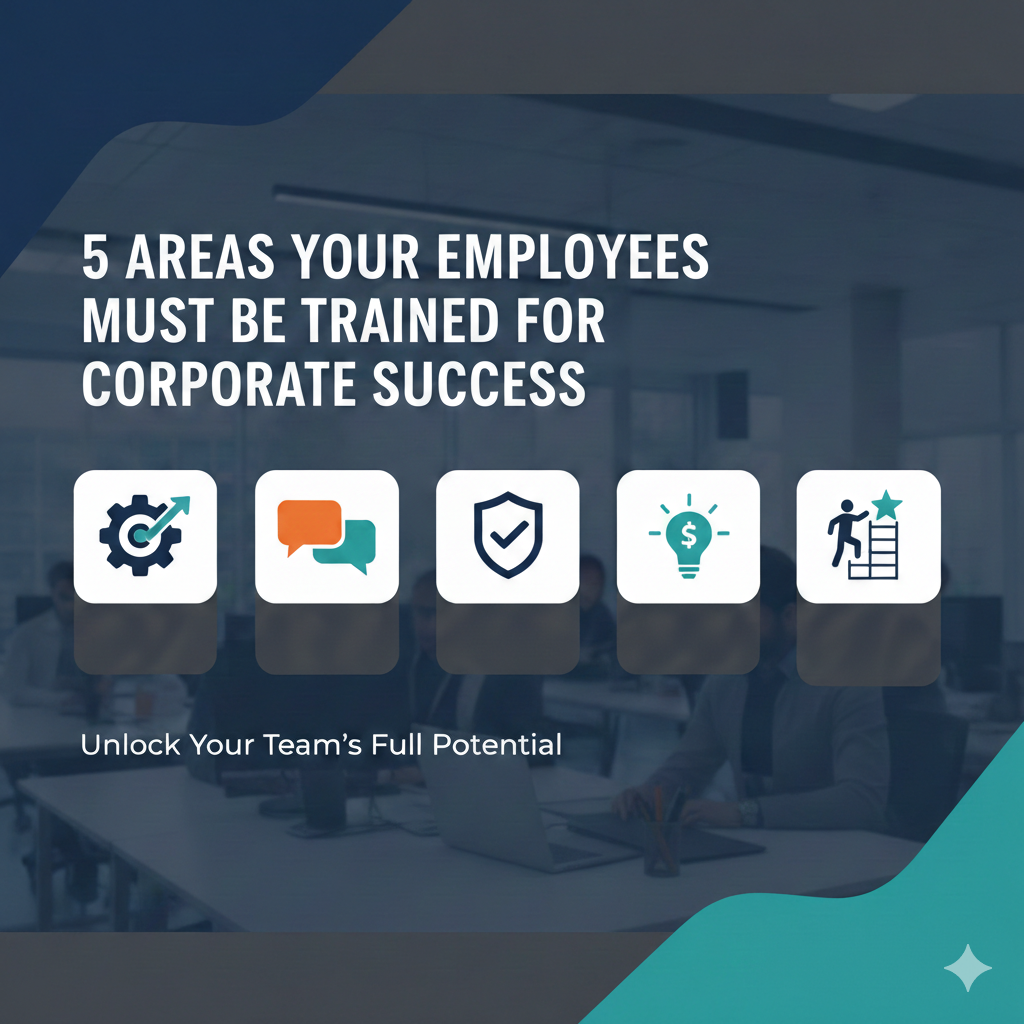
Smart companies aren’t waiting. They’re training employees in 5 critical areas that drive real corporate success. Let me show you exactly what these areas are and why they matter.
Area #1: Leadership and Management Skills
Why It’s Critical:
83% of organizations believe it’s important to develop leadership skills at all levels, yet only 5% have fully implemented this development. That’s a massive gap!
The numbers get worse: 60% of new managers underperform or fail in their first two years. Why? They never got proper leadership training!
What Employees Need to Learn:
Leadership training isn’t just for executives. Every employee needs these skills:
- Making good decisions quickly
- Delegating tasks effectively
- Building strong teams
- Solving conflicts peacefully
- Managing change smoothly
- Motivating others
- Thinking strategically
Real Impact:
Companies investing in leadership development see 37% higher revenue per employee! That’s real money from better leadership.
Plus, good leaders keep teams happy. They inspire people. They make work better for everyone!
How to Train:
Leadership training works best with hands-on practice. Role-plays, interactive case studies, and dialogues with peers to share experiences build confidence and adjust behaviors in a way that self-paced learning seldom can.
Use your learning management system to deliver:
- Video lessons on leadership basics
- Scenario-based exercises
- Peer discussion forums
- Mentorship matching
- Regular feedback sessions
Area #2: Digital Skills and AI Fluency
Why It’s Critical:
Global spending on digital transformation technologies and services is expected to reach $2.3 trillion by 2026. Companies everywhere are going digital!
But here’s the problem: 58% of employees report learning about AI on their own rather than through employer programs. Your team is teaching themselves because you’re not!
What Employees Need to Learn:
Digital training covers many important areas:
- Using AI tools like ChatGPT effectively
- Understanding cloud computing basics
- Analyzing data properly
- Staying safe online (cybersecurity)
- Using company software confidently
- Adapting to new tech quickly
- Knowing when AI helps and when humans lead
Real Impact:
Workers with advanced AI skills earn 56% more than others! That’s huge motivation for learning.
Plus, digitally skilled workers get more done. They solve problems faster. They work smarter, not harder.
How to Train:
Career development champions are 42% more likely to be frontr unners in generative AI adoption. Make digital skills part of your culture!
Use employee training software to create:
- Short tutorials on specific tools
- Hands-on practice projects
- “AI fluency” paths by job role
- Regular updates as tech changes
- Safe spaces to experiment
Area #3: Soft Skills and Emotional Intelligence
Why It’s Critical:
Technology is important, but humans skills matter more! Soft skills training jumped from 38% to 47% of organizations in just one year.
Why? Because AI can do technical tasks. But AI can’t:
- Build real relationships
- Show empathy
- Communicate with feeling
- Read body language
- Inspire trust
What Employees Need to Learn:
These human skills make the difference:
- Communicating clearly (speaking and writing)
- Listening actively to others
- Working well in teams
- Solving problems creatively
- Managing time effectively
- Handling stress positively
- Understanding emotions (theirs and others’)
- Adapting to change smoothly
Real Impact:
Workplaces where emotional intelligence training is prioritized have higher employee satisfaction rates, which reduces turnover and attracts top talent.
Happy employees stay longer. They work better. They help each other more!
How to Train:
Work with team leads to identify the biggest opportunity areas, then make a plan to deliver content that fits those needs.
Your corporate LMS software should deliver:
- Video examples of good communication
- Group exercises for teamwork
- Self-assessment tools
- Real-world scenario practice
- Feedback from peers and managers
Area #4: Compliance, Safety, and Risk Management
Why It’s Critical:
Ensure your staff members know and comprehend the laws and rules that apply to your sector. This is essential to reduce risks and stay out of legal trouble.
Breaking rules costs millions! One HIPAA violation = ₹100+ per record. One OSHA fine = ₹7,000-13,000. Companies can’t afford to skip this training!
What Employees Need to Learn:
Every industry has specific rules:
- Healthcare: HIPAA privacy, patient safety, infection control
- Manufacturing: OSHA safety, equipment operation, hazard awareness
- Finance: Anti-money laundering, data security, fraud prevention
- All Industries: Harassment prevention, data protection, ethics
Real Impact:
One company deployed safety training across all plants and saw accidents drop 34%! That saved them ₹120,000 in insurance costs alone.
Compliance training also passes audits easily. When inspectors arrive, you’re ready with instant proof!
How to Train:
Compliance training is an area where instructor-led training can make a huge difference in effectiveness. Given the disengagement many employees feel with canned eLearning modules, introducing ILT, even in smaller but engaging sessions, can greatly improve key information retention and application.
Your employee training software should include:
- Automatic course assignments by role
- Built-in certification tracking
- Smart expiration reminders
- Engaging interactive content
- Audit-ready instant reports
Area #5: Continuous Learning and Adaptability
Why It’s Critical:
32% of the skills needed for the average job in 2024 are different from those needed in 2019. Skills change fast!
85% of employers plan to prioritize upskilling and reskilling their current workforce over the next 5 years. Companies know they must keep training or fall behind!
What Employees Need to Learn:
This is about building a learning mindset:
- How to learn new things quickly
- Finding good learning resources
- Asking smart questions
- Staying curious always
- Seeing change as opportunity
- Teaching others what you learn
- Taking ownership of growth
- Trying new approaches bravely
Real Impact:
In 2026, your ability to build new capabilities will matter more than any single technology choice. Companies that learn fast win!
94% of employees stay longer at companies investing in development. Make learning a habit and keep your best people!
How to Train:
The best organizations are building ecosystems of learning, not just events on a calendar.
Create continuous learning through:
- Microlearning (5-minute lessons anytime)
- On-demand content libraries
- Peer learning communities
- Regular skill challenges
- Career path planning tools
- Recognition for learning
Why EuctoVerse Delivers All 5 Training Areas Perfectly
Training employees in five different areas sounds overwhelming. Where do you start? How do you manage it all?
That’s where the right learning management system changes everything!
EuctoVerse stands out as the number one corporate LMS software for comprehensive training across all critical areas.
Complete Course Coverage
EuctoVerse includes ready-to-use courses covering:
- Leadership: Manager training, decision-making, team building
- Digital & AI: Technology tools, AI fluency, digital transformation
- Soft Skills: Communication, emotional intelligence, collaboration
- Compliance: Industry-specific regulations, safety, ethics
- Continuous Learning: Self-directed paths, microlearning, career development
Everything your team needs in one platform!
AI-Powered Personalization
The platform’s “Living Learning Ecosystem” uses AI to:
- Recommend next courses based on role
- Adjust content difficulty automatically
- Identify skill gaps before they hurt
- Suggest learning at the perfect time
- Create personalized paths for each person
No more one-size-fits-all training!
Engaging Delivery Methods
Employee training trends in 2026 are all about flexibility: on-demand microlearning, podcasts, bite-sized videos, or quick scenario-based modules.
EuctoVerse delivers exactly this:
- 5-minute microlearning videos
- Interactive scenario practice
- Gamification with points and badges
- Mobile apps for anywhere learning
- Blended learning options
- Live session integration
Automatic Tracking Across All Areas
See exactly which training areas are strong and which need attention:
- Leadership skill development progress
- Digital competency assessments
- Soft skills improvements
- Compliance completion and expiration
- Continuous learning engagement
Real-time dashboards show everything instantly!
Fast Implementation
Most platforms take months to set up. EuctoVerse launches in just 4 days:
- Day 1: Identify which of the 5 areas need priority
- Day 2: Configure courses and learning paths
- Day 3: Test with sample employees
- Day 4: Launch to everyone!
Start training immediately, not next quarter!
Affordable for All Companies
Enterprise features don’t require enterprise budgets!
EuctoVerse starts at ₹30,000 monthly for 200 employees. That’s only ₹150 per person for:
- All 5 critical training areas
- Unlimited courses
- Mobile apps
- AI personalization
- Complete analytics
- Integration with your tools
The Bottom Line
Corporate success in 2026 requires training in all 5 critical areas:
- Leadership – 60% of new managers fail without it
- Digital & AI – 58% learn on their own because companies don’t teach
- Soft Skills – Humans skills AI can’t replace
- Compliance – Avoid expensive fines and accidents
- Continuous Learning – 85% of companies prioritizing this
The stakes are high:
- 47% of employees lack needed skills right now
- 39% of technical skills become outdated by 2030
- Companies with proper training are 17% more productive and 21% more profitable
You can’t afford to skip any of these areas. Your employees need all five to drive real corporate success!
Ready to train your team in all 5 critical areas? Visit www.euctoverse.com or email support@euctoverse.com today. Discover how the #1 corporate LMS software delivers complete training that drives measurable business results. Your success starts with skilled employees. Start training now!
Frequently Asked Questions (FAQs)
1. Why are these 5 training areas most important for corporate success?
These five areas address the complete employee development spectrum essential for 2026 business success. Leadership training is critical because 60% of new managers fail without proper development, and companies with leadership programs see 37% higher revenue per employee. Digital and AI skills are non-negotiable as global digital transformation spending reaches $2.3 trillion and 58% of employees currently learn AI on their own without employer support. Soft skills matter because AI handles technical tasks but can’t replace human abilities like empathy, communication, and emotional intelligence. Compliance training prevents costly violations and accidents, with proper safety training reducing incidents by 34%. Finally, continuous learning capability is vital because 32% of job skills changed in just five years and 85% of employers prioritize ongoing upskilling.
2. How often should employees be trained in these areas?
Training frequency varies by area and should be continuous rather than one-time events. Compliance and safety training require annual refreshers as regulations change, with some industries mandating quarterly updates. Leadership development works best as ongoing programs spanning 6-12 months with regular practice and coaching sessions. Digital and AI skills need continuous updating because technology evolves rapidly—58% of employees currently self-teach because employer programs lag behind. Soft skills benefit from quarterly workshops combined with daily application and feedback. Continuous learning isn’t a single training but a cultural shift requiring constant access to learning resources through employee training software. Best practice combines structured quarterly programs for each area with continuous microlearning available anytime through learning management systems.
3. Can small companies afford comprehensive training across all 5 areas?
Absolutely! Modern cloud-based learning management systems make comprehensive training accessible to organizations of all sizes. EuctoVerse offers all five training areas starting at ₹30,000 monthly for 200 employees (just ₹150 per person), including unlimited courses, AI personalization, mobile apps, and complete analytics. This investment pays for itself quickly—companies with proper training are 17% more productive and 21% more profitable. You can start with priority areas (typically compliance first, then role-specific skills) and gradually expand. Many small businesses see positive ROI within 6-12 months through reduced turnover (94% of employees stay longer with development opportunities), faster onboarding, and improved performance. The real question isn’t cost but whether you can afford NOT to train when competitors are developing skilled workforces.
4. How do you measure if training in these areas is actually working?
Measuring training effectiveness requires connecting learning outcomes to business metrics. For leadership training, track promotion readiness, team performance improvements, and manager retention rates. Digital and AI skills show impact through productivity gains, faster task completion, and adoption rates of new tools. Soft skills measurement comes from 360-degree feedback, customer satisfaction scores, and team collaboration metrics. Compliance training success shows in zero violations, passing audits, and reduced incidents or accidents. Continuous learning tracks participation rates, voluntary course completion, and skills acquired over time. Best practice uses employee training software with built-in analytics showing completion rates, assessment scores, time-to-competency, and correlation between training and performance improvements. EuctoVerse provides real-time dashboards connecting training data to business KPIs proving ROI.
5. What’s the best way to deliver training across these different areas?
Effective delivery combines multiple methods suited to each area’s unique needs. Leadership training works best with blended approaches—video lessons for concepts, role-plays for practice, and mentorship for application, as instructor-led sessions build confidence better than self-paced learning alone. Digital and AI training requires hands-on practice with actual tools in safe sandbox environments. Soft skills need interactive scenarios, peer discussions, and real-world application with feedback. Compliance benefits from engaging short modules with assessments proving comprehension, delivered through corporate LMS software for automatic tracking. Continuous learning thrives with always-available microlearning libraries employees access on-demand. Modern platforms like EuctoVerse deliver all these methods—video lessons, interactive simulations, mobile access, gamification, live session integration, and peer forums—in one system, with AI personalizing the experience for each learner based on role, pace, and preferences.