Introduction
Most businesses don’t fail compliance audits because they skipped training.
They fail because they can’t prove it happened.
That’s the real problem. Not effort. Not intention. Documentation. When a regulator asks for records, “we did the training” isn’t an answer. Timestamped, individual, verifiable proof is.
Right now, somewhere in your organisation, compliance certificates are sitting in someone’s email. Training records are split across three spreadsheets. A new hire started six weeks ago and nobody assigned their mandatory safety modules.
You won’t know any of this until an auditor asks.
A compliance training LMS doesn’t just deliver training — it builds the paper trail automatically, every single time.
Here’s exactly how it works.
Why Compliance Training Has Become More Complicated
There was a simpler time. A classroom session once a year. A tick on a form. A laminated certificate on the noticeboard. That worked, more or less.
But the rules have changed. And in 2026, they keep changing fast.
GDPR requires documented data privacy training. It must be traced back to specific people, specific course versions, and specific dates.
OSHA expects verifiable safety records. A single willful violation can carry fines of over $165,000.
FCA and SEC rules require anti-money laundering and ethics training. Every session must be logged with timestamps.
Healthcare organisations juggle HIPAA requirements, infection control renewals, and safeguarding certifications. Often for staff spread across multiple sites and shift patterns.
And none of this is a once-a-year job. Certifications expire. Regulations get updated. New staff join every quarter. Roles change, and training obligations change with them.
Managing this with a spreadsheet is asking for trouble. Spreadsheets don’t send reminders. They don’t flag expired certifications. They don’t generate reports when a regulator walks in.
What an LMS Actually Does for Compliance
Most people think of an LMS as a platform for delivering courses. And yes, it does that.
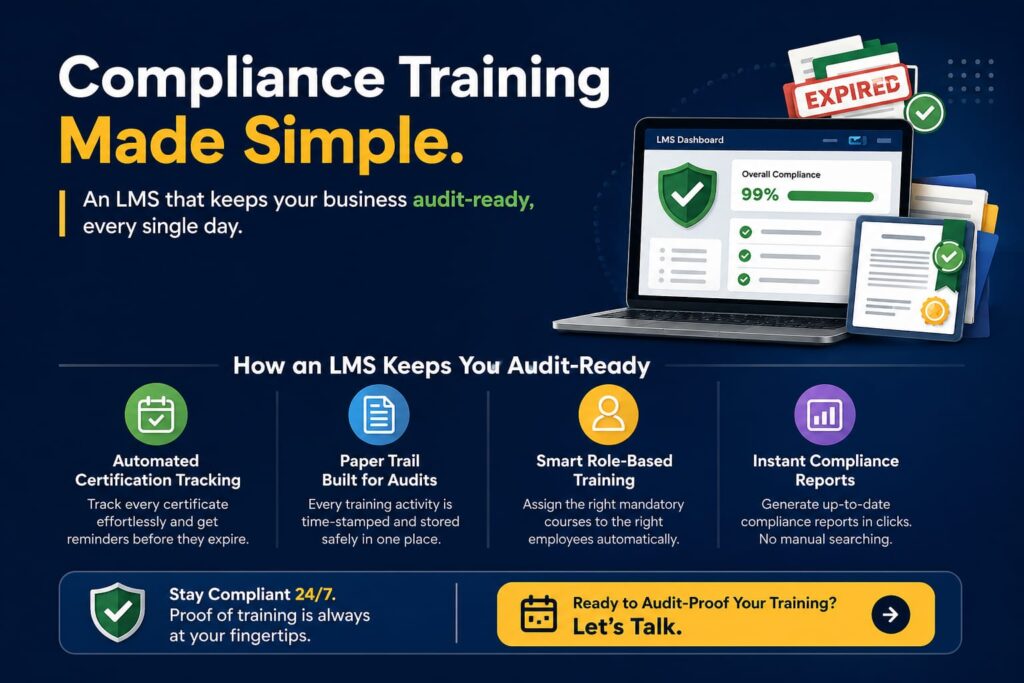
But for compliance, the most valuable thing it does is build documentation. Automatic, structured, tamper-proof documentation. It builds itself in the background every time a learner completes a module, finishes an assessment, or earns a certificate.
Here’s what that looks like in practice
Every Training Activity Gets Logged — Automatically
When an employee starts a course, the LMS records it. When they complete it, that’s logged too. Assessment scores, time spent, number of attempts — all captured without any manual work.
Every record is timestamped.
This is the audit trail regulators want. Not a spreadsheet filled in after the fact. Not a pile of PDF certificates in a shared drive. A system-generated, uneditable record of what happened, when, and who did it.
The Right People Get the Right Training — Without HR Chasing Anyone
Most compliance failures aren’t deliberate. They’re just admin errors.
A new starter doesn’t get enrolled in safety training because their manager was on leave during induction week. A team member gets promoted into a new role with different compliance obligations, and nobody updates their training assignments.
A properly configured LMS handles this automatically. You set the rules once: this role requires these modules, this department needs this certification, any new hire in this location must complete these courses. After that, the system does the assigning. No manual chasing. No gaps.
Certificates Don’t Just Get Issued — They Get Tracked
Issuing a certificate is easy. Tracking when it expires and making sure the employee renews in time is where most manual systems fail.
An LMS tracks the full lifecycle of every certification. Expiry dates are logged at the point of issue. When a renewal window opens — say, 30 days before expiry — the system notifies the employee automatically.
Some platforms go one step further. They re-enroll the employee in the recertification course without anyone having to take action.
In industries where an expired certification is treated the same as no certification at all, this matters enormously.
Reporting Takes Minutes, Not Days
When someone asks for a compliance report — an internal audit, an external regulator, or a senior leadership review — the answer should never be “give me a few days.”
An LMS lets you generate reports in minutes. Filter by department, training type, date range, completion status, or certification validity. Show who’s compliant, who isn’t, and who’s approaching a deadline.
Export it, share it, present it. Whatever the auditor needs.
This is where organisations with a compliance LMS have a real advantage. While others are pulling all-nighters to reconstruct records, you’re sending a clean report by lunchtime.
The Industries Where This Matters Most
Compliance pressure varies by sector. But some industries feel it more than others.
Healthcare sits at the sharp end. HIPAA training, infection prevention, medication safety, safeguarding — the list of mandatory certifications is long. The consequences of gaps can be clinical as well as regulatory. With staff working across shifts and sites, mobile-first learning and automated recertification aren’t optional extras. They’re operational necessities.
Financial services face some of the most scrutinised regulations around. Anti-money laundering, anti-bribery, data protection, conduct risk — all of it requires clear documentation. Firms that can’t produce clean records quickly tend to attract additional scrutiny.
Manufacturing and construction face a specific challenge. Their compliance training isn’t just about regulatory risk — it’s about physical safety. OSHA compliance, PPE protocols, COSHH awareness — if someone is injured and the training records are incomplete, that gap becomes Exhibit A in legal proceedings. An LMS doesn’t just protect you from regulators. It protects you from litigation.
Technology companies handling European data are finding that GDPR isn’t a one-time onboarding task. Regulators want evidence of ongoing awareness training and refresher programs as the rules evolve. And the requirement extends beyond the IT and legal teams to everyone who handles personal data.
Small businesses are often the most surprised. There’s a common assumption that compliance is an enterprise problem. It isn’t. Employment law, health and safety, and data protection apply to a 15-person company just as much as a 1,500-person one. The difference is that a small business has no dedicated compliance team. Which is exactly why an LMS pays for itself fastest at a smaller scale.
What to Look For in a Compliance LMS
Not every LMS is built with compliance as a priority. Some are great for learning but fall short when it comes to audit readiness.
Here’s what to actually look for.
Automated enrollment logic. The system should assign courses based on role, location, or employment status. Manual assignment creates gaps.
Tamper-proof audit logs. A record that can be edited after the fact has no legal standing. Look for immutable logs with timestamps that cannot be altered.
Certificate versioning. Auditors increasingly want to know which version of a course an employee completed. As regulations change, course content gets updated. The system needs to track this.
SCORM and xAPI support. If you use third-party compliance content — and most organizations do—the LMS needs to support the protocols that transfer completion data properly. Without this, training can happen and leave no lasting record.
Flexible reporting. You need to slice data by team, certification type, location, and date range. Different auditors want different views. A single static report won’t cut it.
Mobile access. Frontline and shift workers can’t always complete training at a desk. If your LMS isn’t mobile-friendly, you already have a compliance gap.
HR system integration. When an employee’s role changes in your HRIS, that change should flow through to their training assignments automatically. Manual updates between systems create errors and lag.
How Eucto Verse LMS Handles Compliance
Eucto Verse wasn’t built as a generic course delivery platform with a reports tab bolted on.
It’s built around the idea that learning must produce measurable, defensible outcomes. And compliance is one of the most defensible outcomes there is.
The centralised dashboard gives training managers a live view of where every learner stands. What they’ve completed. What’s outstanding. What’s coming up for renewal.
Assessments are built in as a core feature — not an afterthought. When an employee receives a certificate, it’s backed by a scored assessment, not just a course completion click.
The notification system runs in the background. It keeps everyone informed of upcoming deadlines, new assignments, and certification renewals without any manual prompting.
Every training interaction — every login, every assessment, every certificate — is recorded automatically and tied to a timestamped audit trail that builds itself.
And because Eucto Verse is available on both iOS and Android, compliance training can happen wherever your team is. In distributed organisations, that’s often not at a desk.
CONCLUSION
Compliance isn’t a once-a-year checkbox. It’s a daily operational responsibility — and the businesses that treat it that way are the ones that sail through audits while everyone else scrambles.
The difference isn’t effort. It’s infrastructure.
A compliance training LMS gives you that infrastructure. Automatic enrollment. Tamper-proof audit logs. Certificate tracking that runs itself. Reports that take minutes, not days.
You don’t need to wait for a regulator’s notice to find out where your gaps are. With the right system in place, you already know — and they’re already closed.
Eucto Verse LMS was built for exactly this. Not a generic platform with compliance bolted on as an afterthought. A system designed from the ground up to make your training records airtight, your certifications current, and your next audit the easiest one you’ve ever had.
Ready to see it in action? Book a free demo — no sales pitch, just a straight walkthrough of how Eucto Verse keeps your business audit-ready, every single day.
FAQ
1.We’re a small business is this really necessary for us?
Almost certainly yes. Data protection, health and safety, and employment law don’t have a headcount threshold. Small businesses have more to lose from a failed audit. They don’t have the resources to absorb a large fine or the legal team to fight it.
2.We already do compliance training manually. Why change?
Because manual systems have hidden failure modes. The spreadsheet looked complete until someone asked about two employees in the Manchester office. The certificates were in a personal folder on a laptop. The reminder email got buried, and no one noticed until three months after the certification lapsed.
3.How do we prove which version of a course an employee completed?
This is where SCORM compliance and course versioning matter. A properly configured LMS ties each completion record to the specific version of the course that was active at the time. When regulations change and course content is updated, the system knows who completed which version — and can flag who needs to redo it.
4. Can an LMS replace our physical training documentation?
For most regulatory purposes, yes. Audit trails from a properly configured LMS are generally considered more reliable than manual records. They’re timestamped, uneditable, and complete. Some highly regulated industries may have additional requirements. But for most businesses, a well-implemented LMS covers the documentation obligations.
5.How much time does this actually save?
Organizations using dedicated compliance training software typically cut audit preparation time by around 70%. That reflects the difference between spending days pulling together records from multiple sources versus running a report in ten minutes.