Training Management system vs Learning Management system: What’s the Difference and Which One You Need
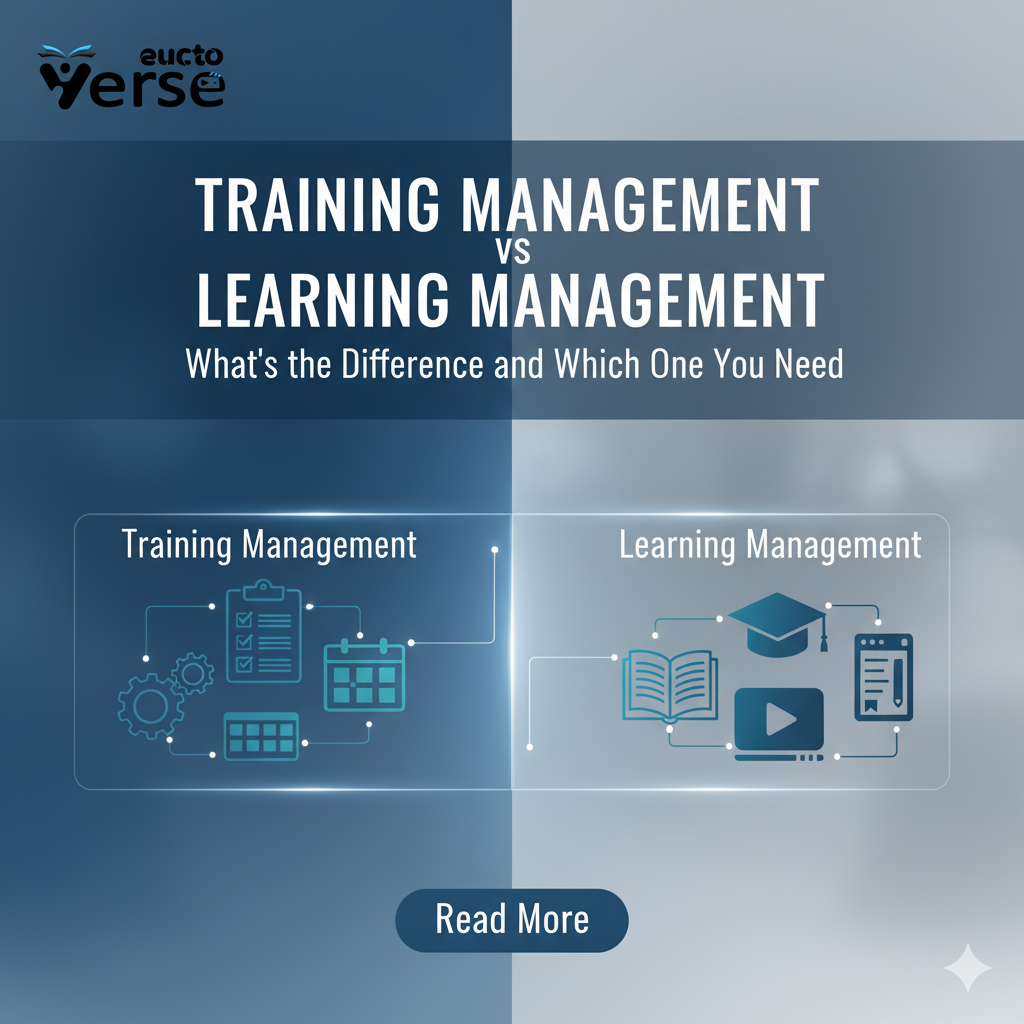
In 2025, effective employee training has become a cornerstone of organizational success. As the corporate world moves further into the digital era, the question arises: Which system should you choose for training management — a Training Management System (TMS) or a Learning Management System (LMS)?
For many enterprises, the decision is not straightforward. Both platforms offer unique functionalities that can significantly improve employee training and development. Understanding the key differences between TMS and LMS, and how each contributes to business growth, will help you make an informed decision about which solution aligns best with your company’s goals.
In this blog, we will explore the differences, uses, and the key features of each system, with a special focus on how EuctoVerse LMS can revolutionize corporate training in 2025. Let’s dive into how the best LMS software helps businesses enhance their training programs while also providing solutions for common challenges that modern enterprises face.
What Is a Learning Management System (LMS)?
A Learning Management System (LMS) is a software platform that helps organizations create, manage, and deliver learning content to employees, customers, or partners. LMS solutions allow businesses to deploy and monitor various types of training content such as eLearning courses, videos, quizzes, certifications, and more.
The primary objective of an LMS is to streamline and automate the training process, making it easier for employees to access training materials, track their progress, and stay compliant with industry regulations.
Key Features of an LMS
Content Delivery: Manage and deliver a wide range of training content, including online courses, live sessions, and materials like PDFs and videos.
Progress Tracking: Automatically track employee learning and performance through reports, completion rates, quizzes, and assessments.
Certification Management: Automate certification processes, including issuing and tracking completion certificates.
Mobile Accessibility: Allow employees to access training programs on mobile devices for flexible learning.
Scalable Learning: As the organization grows, an LMS can scale with the business, delivering content to thousands of employees globally.
Benefits of an LMS
Ensures uniform training experiences across locations.
Provides comprehensive tracking and reporting.
Reduces time and cost associated with in-person training.
Facilitates compliance with industry regulations.
Popular LMS Solutions:
SAP Litmos
Moodle
TalentLMS
What Is a Training Management System (TMS)?
A Training Management System (TMS) is primarily focused on managing the logistical aspects of training programs within an organization. Unlike an LMS, which focuses on delivering content, a TMS ensures that all administrative and operational processes associated with training are streamlined and efficient.
A TMS is designed to manage the coordination of training programs, including scheduling, registration, instructor management, and reporting. Essentially, a TMS helps organizations keep track of the who, when, where, and how of training.
Key Features of a TMS
Training Scheduling: Plan and schedule training sessions, both virtual and in-person, ensuring that sessions are properly coordinated with instructors and employees.
Instructor Management: Assign qualified trainers to specific courses and manage their schedules.
Employee Registration: Allow employees to register for training sessions and track their participation.
Training Budgeting: Monitor training expenses and ensure that they align with the company’s budget.
Reporting: Generate reports on employee attendance, trainer effectiveness, and other logistical aspects of the training program.
Benefits of a TMS
Simplifies the scheduling and management of in-person training sessions.
Ensures that instructors are efficiently managed and assigned to courses.
Provides better resource allocation and cost management.
Supports centralized training administration and reporting.
Popular TMS Solutions:
Saba Cloud
PeopleFluent
Kallidus
TMS vs LMS: The Key Differences
While TMS and LMS may sound similar, their functionalities differ significantly, and they cater to different aspects of corporate training. Let’s break down the key differences:
1. Focus and Purpose
LMS: An LMS is primarily focused on learning delivery and tracking. It enables businesses to manage content, train employees, and track their progress.
TMS: A TMS is focused on the administrative aspects of training. It helps businesses schedule, register, and manage training events, while focusing on logistics rather than content delivery.
2. Learning vs. Logistics
LMS: Deals with content creation, delivery, and assessment. It’s about ensuring that learning happens effectively and tracking learner progress.
TMS: Handles organizational tasks such as scheduling, trainer management, and budget tracking, ensuring that the logistics of a training program run smoothly.
3. Content Delivery
LMS: Offers tools to deliver eLearning courses, assessments, certifications, and multimedia content.
TMS: Focuses on managing instructor-led training (ILT) sessions, but does not provide tools for content creation or delivery.
4. Reporting and Analytics
LMS: Provides detailed reports on learner progress, completion rates, quizzes, and other metrics tied to learning outcomes.
TMS: Provides reports on training attendance, costs, and trainer performance, which are vital for operational and logistical analysis.
5. Integration and Scalability
LMS: Modern LMS platforms are designed to scale and integrate with other enterprise systems such as HR software, performance management systems, and CRM tools.
TMS: While it offers robust scheduling and resource management, TMS solutions may not scale as effectively as an LMS when it comes to content delivery and learner engagement.
Which System Should You Choose in 2025?
In 2025, businesses need training solutions that align with their digital transformation and embrace remote or hybrid work models. While both TMS and LMS offer unique benefits, Learning Management Systems are becoming the go-to solution for corporate training in the modern workplace.
When to Choose LMS
If your workforce is remote or hybrid, and you need to deliver training digitally.
If your organization wants to track employee progress, engagement, and certifications in real-time.
If you need a solution that integrates with other business tools like HR software, performance management systems, and analytics platforms.
When to Choose TMS
If your organization relies heavily on instructor-led training (ILT), with in-person or scheduled training sessions.
If your focus is on training logistics — scheduling, registration, trainer assignments, and cost management.
If your team is smaller or still in the process of moving from in-person to digital training.
Combining LMS and TMS
Many modern platforms, such as EuctoVerse LMS, combine both LMS and TMS functionalities. This hybrid solution allows companies to manage both content delivery and training logistics in one unified platform.
Why EuctoVerse LMS Is Your Best Choice for Corporate Training in 2025
EuctoVerse LMS is the ideal solution for organizations that need both LMS and TMS functionalities in one platform. Here’s why:
Unified Learning Solution: EuctoVerse LMS offers both content delivery (online courses, videos, quizzes) and training logistics (scheduling, trainer management), giving you a complete solution.
Real-Time Analytics: Track employee progress, assess skill gaps, and align training with business performance using powerful analytics.
Mobile-First Learning: With mobile access, your employees can learn anytime, anywhere, ensuring higher engagement and retention.
Scalable and Customizable: EuctoVerse is designed to grow with your organization, supporting both small teams and global enterprises.
Cloud-Based Platform: Enjoy the flexibility and scalability of a cloud-based LMS with secure data storage, easy access, and integration with other enterprise systems.
EuctoVerse LMS simplifies both training content delivery and management logistics, making it the most efficient solution for corporate training in 2025.
Frequently Asked Questions (FAQs)
1. What is the difference between a Training Management System (TMS) and a Learning Management System (LMS)?
A TMS focuses on the administrative aspects of training, such as scheduling and registration, while an LMS focuses on delivering training content and tracking learner progress.
2. How does EuctoVerse LMS handle both TMS and LMS functionalities?
EuctoVerse LMS integrates the benefits of both systems, offering tools for training logistics (scheduling, trainer management) and content delivery (courses, videos, assessments) in one platform.
3. Can EuctoVerse LMS integrate with other business tools?
Yes, EuctoVerse LMS integrates seamlessly with other enterprise tools such as HR software, CRM systems, and performance management platforms to provide a unified experience.
4. Is EuctoVerse LMS suitable for global organizations?
Absolutely. EuctoVerse is designed to scale globally, offering multi-language support, mobile access, and a cloud-based infrastructure to ensure consistency across locations.
5. How does EuctoVerse LMS improve training ROI?
EuctoVerse LMS reduces costs, improves training engagement, and offers real-time analytics to help businesses align learning outcomes with performance, ensuring a measurable ROI.
Conclusion
As we head into 2025, organizations must choose training systems that support digital transformation, enhance employee engagement, and drive business outcomes. The EuctoVerse LMS provides a comprehensive solution for both training delivery and management logistics, ensuring your organization is equipped with the tools needed to achieve 3× productivity gains in employee training.
By integrating the best of both TMS and LMS functionalities, EuctoVerse is the future of corporate learning.
EuctoVerse — The Gateway to Smarter Learning.
Explore more and book a free demo at www.euctoverse.com