
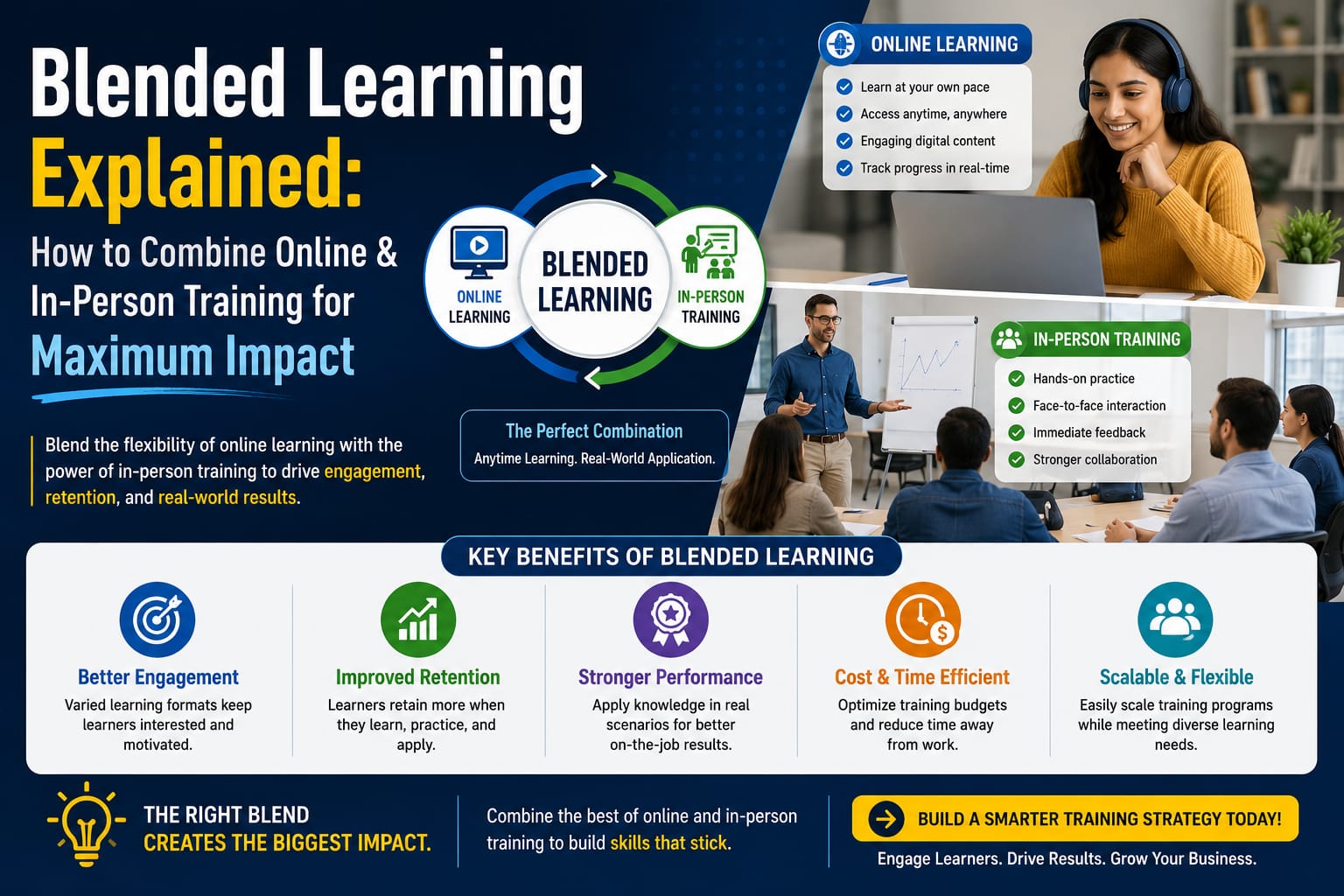
Blended Learning Explained: How to Combine Online & In-Person Training for Maximum Impact
Training programs don’t fail because teams stop caring. They fail because the content doesn’t match the format — and that gap quietly kills results.Blended learning was built to close that gap. It brings online and in-person training together, so each one does what it does best. Learners get flexibility without losing human connection. Organizations get results they can actually measure.This guide covers how blended learning works, which model fits your team, and how to build a program that sticks.
What Actually Is Blended Learning?
Ask three L&D professionals and you’ll get four different answers. So let’s cut through it.Blended learning is the deliberate combination of online digital learning and face-to-face instruction — designed so that each format does what it does best. The operative word there is deliberate. Throwing a PDF on your LMS and calling your workshop ‘blended’ doesn’t count.True blended learning has three things going on at once:
- Learners have to show up somewhere in person — even occasionally — for at least part of the training
- Online components give them some control over when and how they engage with content
- The two formats are designed to feed into each other, not sit in separate silos
Why It Works: The Honest Science
There’s a reason most corporate training doesn’t stick — and it’s not that employees are disengaged. It’s that we keep delivering information in ways the brain isn’t built to hold onto.
Hermann Ebbinghaus figured this out in the 1880s. Without reinforcement, people forget roughly 70% of what they learned within 24 hours. The training world has known this for over a century. We just keep building programs that ignore it.
Blended learning works because it fights the forgetting curve at multiple points — not just once.
Here’s what’s actually happening neurologically
When someone encounters an idea online before a live session, their brain starts building an initial scaffold for that concept. When the in-person session then layers application and discussion on top of that scaffold, retention improves dramatically. Then, when online reinforcement revisits the same material afterward, the memory trace gets stronger each time.
That’s spaced repetition working in practice. And it’s not magic — it’s just good instructional design that blended learning naturally enables.
Beyond memory mechanics, there are a few other things worth naming:
- In-person sessions finally get to be about doing, not just listening — because foundational content moved online where it belongs
- Learners who process faster aren’t held back. Learners who need more time aren’t rushed. The online component handles that flexibility
- Video, reading, discussion, roleplay — blended programs cover more learning modalities than any single-format approach can
How to Build a Blended Learning Program: What Actually Works
Start With Outcomes, Not Formats
The single most common mistake in blended learning design is deciding the format before deciding the outcome. Someone says, ‘let’s put the compliance training online,’ and then figures out learning objectives afterward.Flip it. Ask first: what does ‘trained’ actually look like? Can they do the task? Pass the scenario? Change the behavior? Then let those answers dictate the format mix.
Sort Your Content by Format Fitness
Not everything belongs online. Not everything needs a room. Here’s a rough but reliable sorting rule:Put online: any content that transfers information. Policy documents, product specs, process walkthroughs, background reading, foundational terminology. Anything learners could absorb independently — let them do it on their own time.Keep in-person: anything that requires human interaction to actually learn. Roleplay scenarios, coaching conversations, group problem-solving, debriefs, anything where the value comes from the people in the room, not the content on the screen.Either works: case studies, expert Q&As, group projects. These can go either way depending on your team’s size and location.
Choose an LMS That Can Handle Both Worlds
This step is where most organizations underestimate the complexity. They pick an LMS for its eLearning features, then try to bolt on in-person tracking as an afterthought. What you end up with is two separate data streams that never talk to each other.
That’s exactly what EuctoVerse was built to do. The LMS treats online modules and in-person sessions as parts of the same program — because they are.
Design Online Content for Real Human Attention Spans
Here’s something nobody says clearly enough: most people are not sitting at a desk giving your eLearning their full attention. They’re on a phone. Between meetings. With the TV on. On a lunch break.design accordingly. Modules over 15 minutes see a steep drop in completion. The sweet spot right now is 7 to 12 minutes — long enough to cover something meaningful, short enough to finish in a real gap in someone’s day.Make it interactive. Not ‘click next’ interactive. Scenarios. Decision points. Short knowledge checks that actually make someone think. If the learner could walk away from a screen and miss nothing, the content isn’t doing its job.
Measure Learning, Not Just Activity
Completion rates are a vanity metric. I know, because I’ve seen programs with 95% completion rates where the business results didn’t budge an inch.The metrics that actually tell you something:
- Pre-training assessment score vs. post-training score — the gap tells you what the program actually taught
- Completion of online modules before the live session — if people are showing up unprepared, the pre-work isn’t working
- In-person engagement quality — not just attendance, but whether learners were able to apply what they studied online
- 30-60-90 day performance check-ins — are learners actually doing things differently on the job?
- Manager feedback — the people closest to day-to-day performance can often tell you what no dashboard can
Three Real-World Programs That Show How This Works
Theory is useful. Seeing it in practice is better. Here are three blended learning programs across different contexts — built on the same design principles.
New Employee Onboarding
The problem with most onboarding is that it tries to do everything in the first week. Day one is a fire hose. People walk out of orientation having sat through six hours of presentations they’ll mostly forget.a blended approach flips the sequence. Weeks one and two: learners work through self-paced modules on company policy, systems, and product knowledge — all on the LMS, in their own time. By week three, when they come in for the in-person orientation, they already know the basics. That day becomes about the things only humans can deliver: meeting the team, working through real scenarios with their manager, asking questions that the modules couldn’t anticipate.weeks four onward: brief online reinforcement modules, 30-60-90 day check-ins, and manager-led coaching conversations tracked through the LMS.the result: people feel prepared walking in. The in-person day actually moves the needle instead of just covering basics.
Compliance Training in Finance or Healthcare
Compliance is one area where the stakes of poor retention are genuinely high. And it’s one area where pure classroom training consistently underperforms — because people retain information better when they encounter it in chunks, with time to process each piece, rather than absorbing it all in a single session.
Online: regulation-specific modules, 8 to 12 minutes each, built around scenario-based questions after every section — not just multiple-choice recall, but ‘what would you do in this situation’ decision trees.
In-person: a two-hour workshop where teams work through real edge-case files together, facilitated by a subject matter expert. This is where the nuance lives — the stuff that’s hard to learn from a module because it requires judgment and discussion.Online follow-up: a certification assessment on the LMS, with automatically issued certificates on passing. No admin chasing down paperwork.
Leadership Development (The One That Often Gets Overbuilt)
Leadership programs tend to be either massive — years-long, overly structured — or too thin to actually change anything. Blended learning helps you find the middle.
Online: monthly reading packs, reflection prompts, a short leadership style assessment in month one, and occasional video interviews with external experts. Nothing that takes more than 30 minutes in any given week.
In-person: quarterly full-day workshops. Not lectures. Peer coaching triads, structured group challenges, presentations to senior leaders, and honest debriefs. The quarterly rhythm keeps the program alive without burning out participants.
Online between workshops: peer accountability threads inside the LMS, shared reflection journals, and brief progress check-ins that managers can track. The program stays active between sessions instead of fading the moment people leave the room.
What Blended Learning Looks Like in 2026
The fundamentals haven’t changed — good instructional design is still good instructional design. But the tools and learner expectations have shifted enough that a 2019 blended program would look outdated today.
A few things that are genuinely different now:
- AI is inside the LMS now — not as a gimmick, but adapting content paths based on how individual learners are performing. If someone breezes through a module, the system stops making them wait. If someone’s struggling, it surfaces supporting resources automatically.
- Mobile is the primary consumption device for online learning. Not desktop. Not laptop. Phone. Programs that aren’t genuinely mobile-first see completion rates drop off fast — because people aren’t waiting to get back to a desk.
- Asynchronous video has replaced most live lectures. If an expert can record a 10-minute explanation that learners can pause, rewind, and watch at 1.5x speed — that’s a better use of their expertise than making 40 people sit in a room while they talk through slides.
- Analytics aren’t just for reporting anymore. L&D teams are using LMS data in real time to identify which modules are causing drop-off and adjust content mid-program. It’s become a continuous improvement loop, not an end-of-quarter review.
- Learner expectations have risen. People aren’t willing to sit through poorly designed training the way they used to. The bar for ‘good enough’ has moved — and programs that don’t meet it face abandonment, not just low satisfaction scores.
FAQ
1. What’s the actual difference between blended learning and hybrid learning?
They are not the same thing. Blended learning is about how you plan your lessons. You mix online and in-person content so they work together. Hybrid learning is about where learners are. Some sit in class. Others join from home at the same time. You can have all learners in one room and still use blended learning. You can run a hybrid session where the lessons are not planned well at all. One is about how you design lessons. The other is about how you deliver them.
2. What are the real benefits of blended learning for corporate training?
A: Three benefits show up in the data. First, people remember more — retention goes up by as much as 60% compared to classroom-only training. Second, costs drop. When basic content moves online, training costs fall by 30–50%. Third, learners feel more confident — especially in areas like compliance, leadership, and technical skills. There is also one benefit that is harder to measure. When in-person time is used for practice instead of lecture, the relationship between trainer and learner changes. It becomes less about passing on information and more about working through real problems together.
3. How do I decide what goes online versus what stays in the room?
Quick test: can a learner engage with this content meaningfully without another human being present? If yes — it probably belongs online. Policy information, process walkthroughs, product specs, foundational concepts: all of this can and should move online. What stays in person: anything where the learning happens in the interaction itself. Coaching conversations, roleplay scenarios, group debriefs, complex judgment calls — these require a room because the humans in it are the point.
4. What should I look for in an LMS for blended learning?
The non-negotiables: it needs to schedule and manage in-person sessions, not just online courses. It needs to track attendance alongside digital completion metrics. It should allow content gating — so learners can’t skip the pre-work and show up to a live session cold. Assessment and certification should cover the full program, not individual components. And it needs a unified analytics view so you’re not pulling data from three separate places. EuctoVerse was designed with all of these in mind, specifically for trainers and L&D teams running blended programs at scale.
5. How long does it realistically take to launch a blended learning program?
A focused single-topic program — two or three online modules plus one live session — can go from design to launch in two to four weeks if someone is dedicated to building it. A full onboarding or leadership development program typically takes six to twelve weeks when you account for content creation, review cycles, pilot testing, and feedback. The bottleneck is almost always content creation. Platform setup is usually the easy part.
Conclusion
Blended learning doesn’t work because it uses two formats. Plenty of programs use two formats and still fail. It works when someone has made deliberate choices about what each format is for — and designed the program so the two halves actually connect.
The logistics manager’s story from the beginning of this article? She eventually rebuilt her onboarding program with a proper blended design. Pre-work online. In-person time for scenarios and team connection. Ongoing reinforcement through the LMS. Ninety days later, retention scores had improved by 47%. More importantly, managers stopped reporting that new hires ‘didn’t know the basics.’
That’s what this looks like when it works. Not a flashier delivery format. A program that’s actually doing what training is supposed to do.
If you’re ready to build something like that — EuctoVerse LMS gives you everything you need to design, deliver, and track blended learning programs in one place. Not two dashboards, not a
Book a free 30-minute demo — and see what it looks like when your blended program runs the way you designed it.
Book Your Free Demo -> euctoverse.com
Leave a Reply